|
Phnom Penh
City Sights
 Phnom
Penh’s points of interest are largely historical
and cultural, but they are only part of exploring the city. Exotic
shopping, unique dining, indulgent spas and a fair bit of nightlife
complete the Phnom Penh experience. Phnom
Penh’s points of interest are largely historical
and cultural, but they are only part of exploring the city. Exotic
shopping, unique dining, indulgent spas and a fair bit of nightlife
complete the Phnom Penh experience.
For the sights, set aside two or
three days for the major points. Though it is possible to squeeze the
most important sights into a single day, this leaves very little time at
each location. Popular sights include the
Royal Palace
and
Silver Pagoda,
the Toul Sleng Genocide Museum and the Khmer Rouge ‘Killing Fields,’ the
National Museum, the Russian Market, Central Market and
Wat Phnom.
Except for the ‘Killing Fields,’ which are about 16km from the city
center, all of the major sights are inside the city within a five or ten
minute ride of each other.
Other things to do an see
include
traditional performances (including the very popular 'Plae Pakaa/Fruitful'
at the National Museum.) And within
day trips
distance of Phnom Penh there are several Angkorian-era ruins
and as well as other historic sites.
Most people hire
transportation
for half or full day at a time. Consider a cyclo or even a walking tour
for a more intimate look at the city. There is also a new ‘Hop
on-Hop off’ a/c tour bus the circles past all of
the major in-city attractions once per hour, allowing a
flexible itinerary. $15 for one day, $25 for two.
|
|
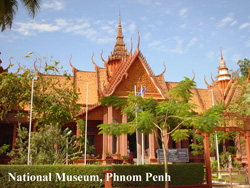 National Museum National Museum
Admission: $5.00
Open: 8:00 - 5:00,
open everyday
Location:
Street 178
& Street 13, next to the Royal Palace
Tel: 023-211753
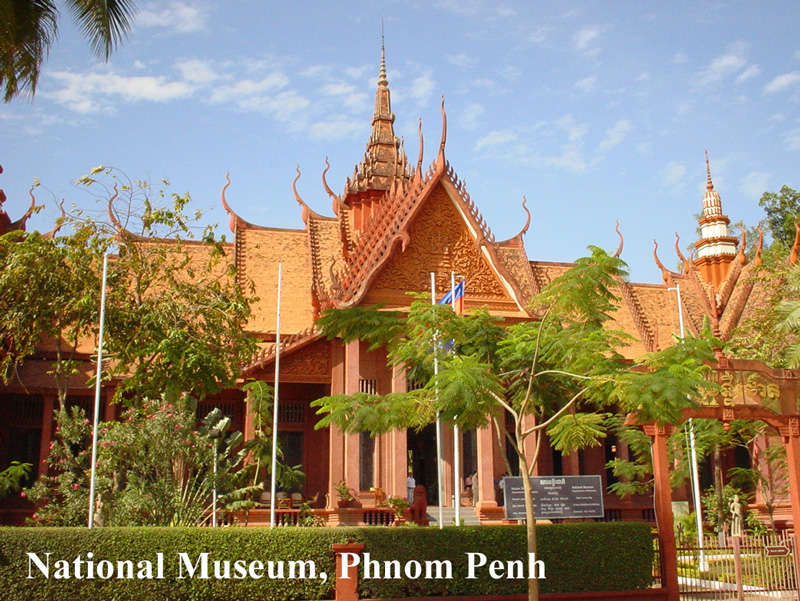
The distinctive rust red National Museum in
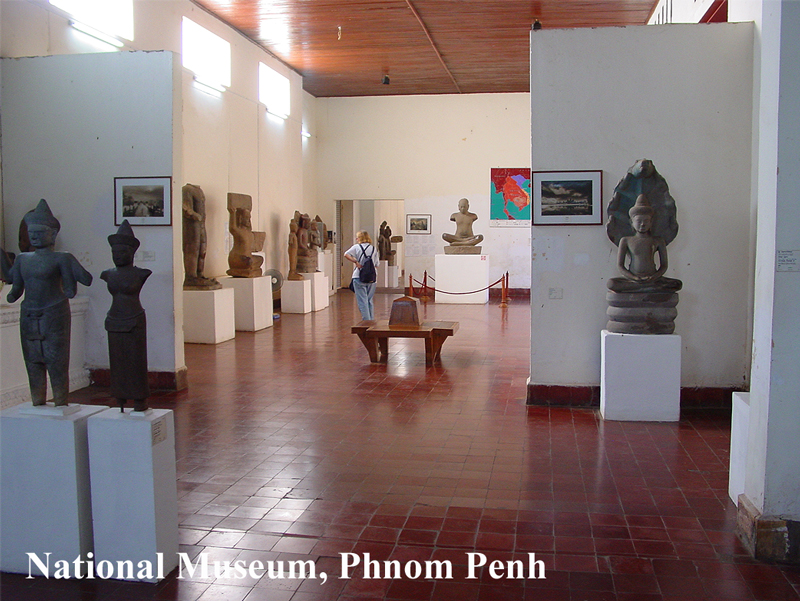
Phnom Penh is the most important repository of Khmer artifacts in the
country. Over 5000 objects are on display including Angkorian era
statues, lingas and other artifacts, most notably the legendary statue
of the ‘Leper King’ from Siem Reap and an enormous 11th century bronze
Vishnu. Though the emphasis is on Angkorian artifacts, there is also a
good collection of pieces from later periods, including an exhibition of
post-Angkorian Buddha figures. Even the museum building itself is of
historical interest, a architectural hybrid of sorts, bearing both
traditional Cambodian and western design elements. Visiting the museum
after rather than before a trip to the Angkor in Siem Reap helps lend
context to the Angkorian artifacts.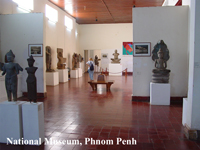
Cambodian Living Arts stages Traditional Cambodian Performances in the
garden of the National Museum on Friday and Saturday at 7:00PM.
Multi-lingual tour guides are available. Souvenirs and books available
including guidebook. Photography is limited.
www.cambodiamuseum.info
|
|
|
|
|
|
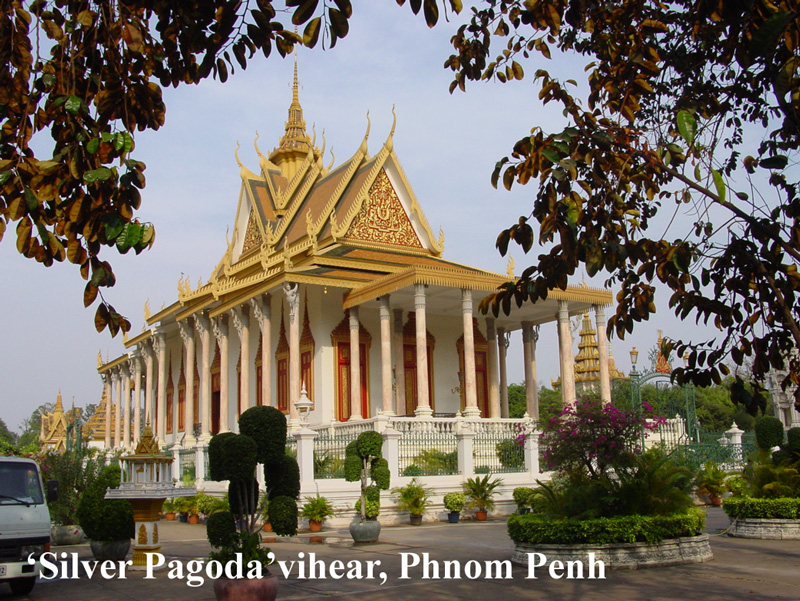
 Royal Palace and Royal Palace and
‘Silver Pagoda’
Admission: 40,000 Riel (US$10)
Open: everyday, 7:30-11:00
/ 2:00-5:00
Location: Sothearos Blvd (riverfront)
between Streets 240 & 184
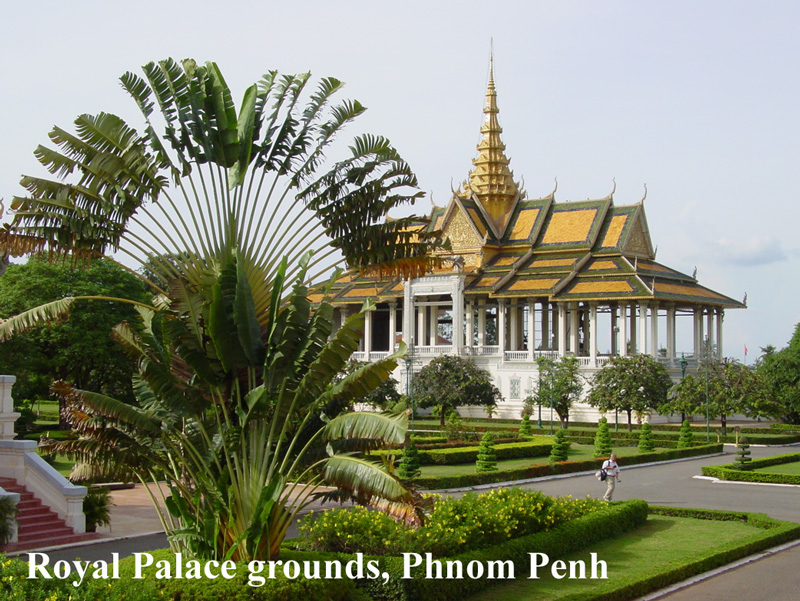
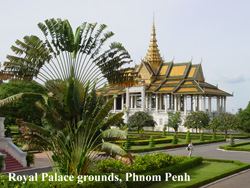
Marking the approach to the Royal Palace along Sothearos Blvd the
high yellow crenellated wall and spired Chanchhaya Pavilion stand
distinctively against the riverfront skyline. Inside the Palace grounds
street sounds are silenced by the high walls and the royal buildings sit
like ornate islands rising from the manicured gardens.
The Royal
Palace serves as the residence of the King, a venue for court
ceremony and as a symbol of the Kingdom. It was first established at its
present location when the capital was moved from Oudong to Phnom Penh in
1866 under King Norodom and the
 French protectorate, though the Palace
did not attain its current general form until about 1920. Khmer and
European elements as well as distinct architectural echoes of the palace
in Bangkok are present in the design of the various buildings. French protectorate, though the Palace
did not attain its current general form until about 1920. Khmer and
European elements as well as distinct architectural echoes of the palace
in Bangkok are present in the design of the various buildings.
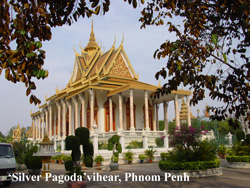
Attached
to the Palace compound, Wat Preah Keo Morokat (the 'Silver
Pagoda') is unique amongst pagodas. So named for its silver tiled
floor, it is where the King meets withmonks, Royal ceremonies are
performed and it houses a collection of priceless Buddhist and
historical objects including the 'Emerald Buddha.' And, unlike most
pagodas, no monks live at the pagoda. The temple building, library and
galleries were first constructed between 1892 and 1902.
See the
Royal
Palace and Silver Pagoda page for more.
|
|
|
|
|
|
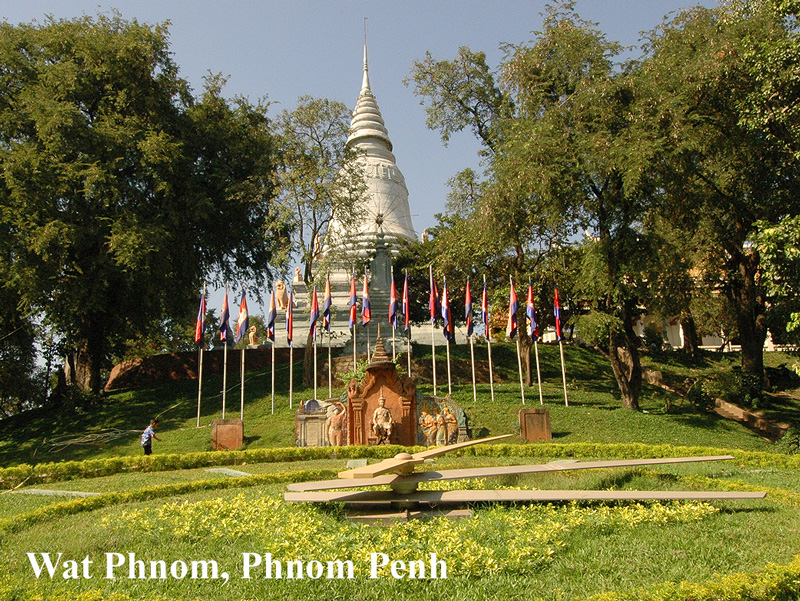
 Wat Phnom Wat Phnom
Admission: $1/person
Location: North end of Norodom Blvd.
at Street 96, in the center of the roundabout
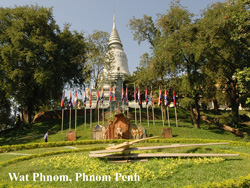
A small hill crowned by an active wat (pagoda) marks the legendary
founding place of the Phnom Penh. The hill is the site of constant
activity, with a steady stream of the faithful trekking to the vihear,
shrines and fortune
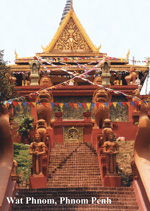 tellers on top and a constellation of vendors,
visitors and motodups at the bottom. tellers on top and a constellation of vendors,
visitors and motodups at the bottom.
The
legend of the founding of Wat Phnom is tied to the beginnings of Phnom
Penh. Legend has it that in 1372 Lady Penh (Yea Penh) fished a floating
Koki tree out of the river. Inside the tree were our Buddha statues.
She built a hill (‘phnom’ means ‘hill’) and a small temple (wat) at what
is now the site known as Wat Phnom. Later, the surrounding area became
known after the hill (Phnom) and its creator (Penh), hence the name of
the city ‘Phnom Penh.’ f
The current temple was last rebuilt in 1926. The
large stupa contains the remains of King Ponhea Yat (1405-1467) who
moved the Khmer capital from Angkor to Phnom Penh the early 15th
century. Look for the altar of Lady Penh between the large stupa and the
vihear. She is said to be of particular help to women.. |
|
|
|
|
|
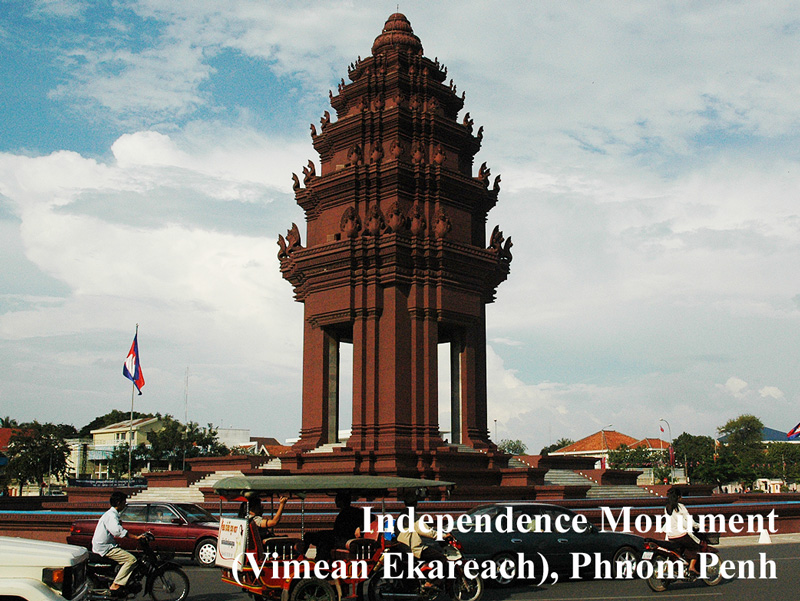
 Independence Monument Independence Monument
Admission: None
Location: At the intersection of
Norodom and Sihanouk Blvds.
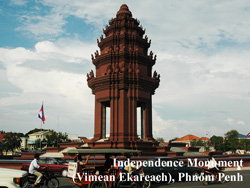
The Independence Monument (Vimean Ekareach) was inaugurated in
November 9, 1962, celebrating Cambodia’s independence from foreign rule.
Renowned Cambodian architect Vann Molyvann was the architect of the
monument which is patterned on a lotus flower bud, adorned with Naga
heads (multi-headed cobras,) and obviously reminiscent in design of the
towers of Angkor Wat.
The Independence Monument now also serves as a
monument to Cambodia’s war dead as well as her independence. The
Independence Monument sit in the center of the traffic circle at the
intersection of Norodom Blvd. and Sihanouk Blvd. and is the site of
colorful celebrations and services on political holidays such as
Independence Day (January 7) and Constitution Day (September 24.) |
|
|
|
|
|
The
Rivers
Situated on the west side of the Tonle Sap
River, Phnom Penh is, before all else, the city at the Chaktomuk on the
Mekong River. - the 'four faces' - riverine crossroads in the heart of
Cambodia with the Tonle Sap River running northwest to the old Angkorian
capital, the Mekong River north to Laos and branches south to the delta
and the South China Sea. (see
Phnom Penh History
page for more)
 The River Front The River Front
Some of Phnom Penh's most important cultural sites as well as dozens of
pubs, restaurants and shops sit along the picturesque park-lined
riverfront overlooking the chaktomuk - the confluence of the
Tonle Sap, Mekong and Bassac
Rivers. The Royal Palace, the Silver Pagoda and the National
Museum are clustered together between
Street 178 and
240 and restaurants and
pubs line the riverfront
road
Sisowath Quay, stretching north from the Royal Palace area
all the way to
Street 104
near Wat Phnom. Visit the Royal Palace and National
Museum and stroll up the riverfront for a drink or a meal or to do
some shopping. Just off the riverfront,
Street 240 behind the Royal
Palace harbors several
restaurants and
high-quality boutiques and
Street 178 next to the National
Museum is known as 'Art Street' and is dotted with interesting
little art galleries and silk shops. Early
risers, check out the spectacular sunrise over the river in front of the
Royal Palace area.
 River Cruises River Cruises
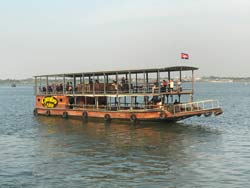
Short river and sunset cruises along the Phnom Penh riverfront are easy
to arrange and offer an interesting view of the city.
A tour cruise typically takes about 1 - 2
hours and runs up the Tonle Sap River along the central riverfront area
providing a picturesque view of the
Royal Palace
and Phnom Penh skyline, and then across the Tonle Sap and up the Mekong
River to view floating fishing villages. (Photography: Best lighting in
the early morning as the low sun illuminates the riverfront.) Longer
cruises are also possible and can be tailored to your requirements -
upriver tours to villages and paddies, dinner and party cruises, sunset
cruises, trips to Silk Island.
Boat trips can be arranged through your
hotel or travel agent or you can deal with the operators directly.
Tourist boats are clustered together on the river along Sisowath Quay
just north of the Phnom Penh Port. Starting at around $20-$25/hour,
depending on the duration and number of passengers.
|
CamboCruise
Regularly scheduled, daily river
cruises and excursions departing the Phnom Penh Floating Port on a
western managed boat. Cruises depart every day, on schedule without
fail. All cruises offer buffet meals (optional), full
bar and lots of extras including live traditional Cambodian music, free filtered water
and exceptionally good service.
The Silk Island
Lunch Cruise departs at Noon and returns at 4:00PM,
including lunch buffet and Silk Island tour. $34 with buffet, $24
without the buffet.
A 2 hour Sunset Dinner
Cruise departs at 5:00PM daily and return at 7:00PM. $24 with buffet, $15
without the buffet.
It is best to book online through the
CamboCruise website,
though you can also book through your hotel or a travel agent, but make
sure to specify that you want the CamboCruise tour. All cruises depart
in front of Yi Sang Riverside / Tourist Information Center, just south
of the Royal Palace. You can usually even just show up at the dock just before
departure. If you do show up without advanced booking, ignore touts at
the Port that try to direct you to other boats.
Tel 092-290077
www.CamboCruise.com
|
|
KKS Travel
Riverboat offering daily sunset (4PM-6PM)
and evening ‘firefly’ (6:30PM-8PM) boat cruises on the Tonle Sap and
Mekong. Music and cold drinks. W.C. on boat.
Tel 016-994161
|
|
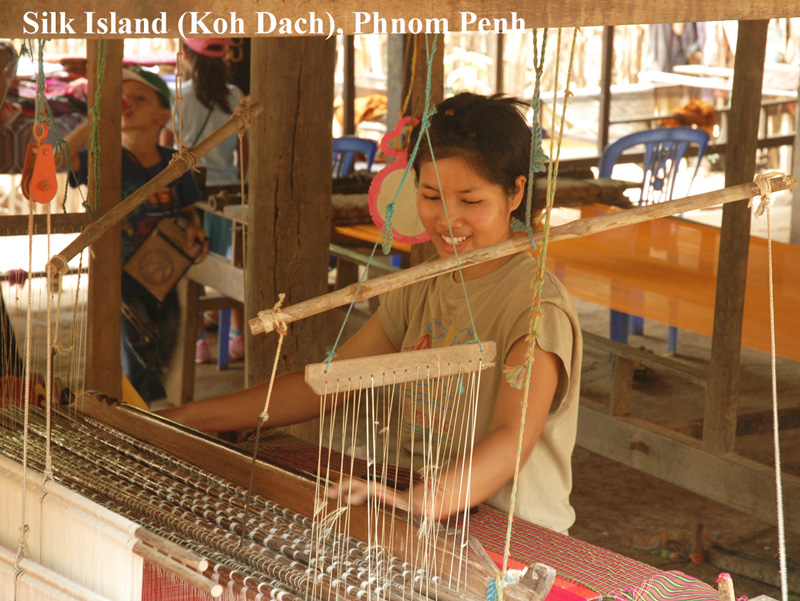
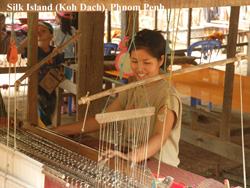 Silk
Island (Koh Dach) Silk
Island (Koh Dach)
Admission: None
Location: In the Mekong River located
about 1-hour boat ride from Phnom Penh. See above for boats to the
island.
For those with an interest in Cambodian silks and silk weaving, set
aside a half-day for a boat trip to a rural weaving village on Koh Dach
(aka ‘Silk Weaving Island,’) a nearby island up the Mekong River. The
weaving village is a typical rural Cambodian village, dedicated almost
entirely to silk weaving - people operating hand looms under most of the
houses, others dying and spinning silk on spinning wheels made of
bicycle parts. The area does not receive a lot of tourists. Wander the
village to observe the activities, and expect silk sellers to try to
hawk their wares.
Arrange a visit through your guesthouse, travel agent or see
tour/boat operators.
CamboCruise (see
above) offers regularly scheduled daily tours to the islands. If you
want to do it yourself boats can be chartered for around $20/hour and
take about 2 hours round trip plus the time you want to spend there. The
boat may stop at ‘Mekong Island’ and some other weaving houses along the
way. Make sure that the boat operator understands that you want to go
all the way to the silk village on Koh Dach.
|
|
|
|
|
|
Phnom Penh City Sights:
Khmer Rouge History
From April 17, 1975 until January 7, 1979,
the brutal, ultra-Communist Khmer Rouge regime (i.e. the Red Khmer)
controlled the whole of Cambodia, then known as 'Democratic Kampuchea.'
The Khmer Rouge was headed by Saloth Sar, nom de guerre Pol Pot. During
their short reign between one and two and a half million Cambodians
perished, some killed outright, others dying from disease, malnutrition,
neglect and mistreatment.
Some of the horrific remnants
of the Khmer
Rouge regime can be seen at the Choeung Ek Memorial (the ‘Killing
Fields’) and the Toul Sleng Genocide Museum. Though the Khmer Rouge were
driven from power in 1979, they retreated to the mountains and border
areas, persisting until their final defeat and dissolution in 1998.
Surviving KR leaders are only now facing the court. Kaing Guek Eav,
a.k.a. ‘Duch,’ director of the infamous S-21 prison was found guilty by
the ECCC in 2010. Proceedings against other defendants are currently
underway. Pol Pot died in 1998, never having faced justice.
|
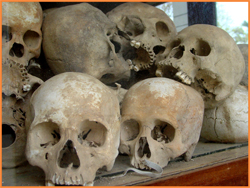 Choeung Ek Memorial Choeung Ek Memorial
(The Killing Fields)
Hours: 7:30AM - 5:30PM
Admission: $6.00
Location:
15 km southwest of Phnom Penh - Take Monireth 8.5 km past the bridge at
Street 271
Many of the Cambodians who perished under the Khmer
Rouge regime ended up dumped in one of the dozens of ‘killing fields’
that can be found scattered across the country. The killing fields were
essentially ad hoc places of execution and dumping grounds for dead
bodies during the Khmer Rouge regime (1975-1979.) After the Khmer Rouge
regime, memorials were set up at many of the sites, some containing the
bones and remnants of victims gathered from the area.
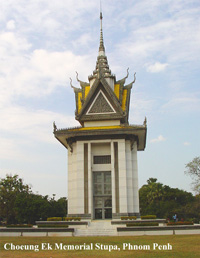 Prior to 1975, Choeung Ek just outside Phnom Penh was a orchard and a Chinese cemetery. But during the Khmer Rouge regime the area became one of the infamous
killing fields. This particular killing field is the site of the brutal
executions of more than 17,000 men, women and children, most of whom had
first suffered through interrogation, torture and deprivation in the
S-21 Prison (now the Toul Sleng Genocide Museum) in Phnom Penh. The
Choeung Ek Memorial is now a group of mass graves, killing areas and a
memorial stupa containing thousands of human skulls and long bones. Prior to 1975, Choeung Ek just outside Phnom Penh was a orchard and a Chinese cemetery. But during the Khmer Rouge regime the area became one of the infamous
killing fields. This particular killing field is the site of the brutal
executions of more than 17,000 men, women and children, most of whom had
first suffered through interrogation, torture and deprivation in the
S-21 Prison (now the Toul Sleng Genocide Museum) in Phnom Penh. The
Choeung Ek Memorial is now a group of mass graves, killing areas and a
memorial stupa containing thousands of human skulls and long bones.
The
memorial is about a 20-40 minute drive from the center of Phnom Penh.
Guided tours through the area are available and reasonably priced
multi-lingual guides are available at the site. There is also a small
souvenir shop as well. For sake of historical context, combine your trip
to Choeung Ek with a visit to Toul Sleng Genocide Museum (the former S-21 Prison) in Phnom Penh. (See below.) Also see David Chandler’s book,
‘Voices of S-21’ for the most systematic and complete account to date of
the history and operation of the S-21 Prison.
|
|
|
|
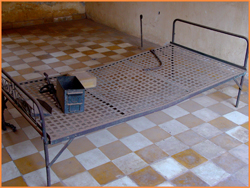 Toul Sleng Genocide Museum (S-21) Toul Sleng Genocide Museum (S-21)
Hours: 8:00AM-5:00PM, daily. Closed for lunch.
Admission: $3.00
Location: Corner of Street
113 & Street 350
Prior to 1975, Toul Sleng was a high school - a set of classroom
buildings in a walled compound. When the Khmer Rouge came to power in
1975 they converted into the S-21 prison and interrogation facility,
administered by Kaing Guek Eav, a.k.a. ‘Duch.’ Inmates at the prison
were held in tiny brick cubicles and systematically tortured, sometimes
over a period of months, to extract the desired ‘confessions,’ after
which the victim was inevitably executed at the killing field of Choeung
Ek just outside the city. S-21 processed over 17,000 people, less than a
score of whom are known to have survived.
The Tuol Sleng compound now
serves as a museum, a memorial and a testament to the madness of the
Khmer Rouge regime. Much has been left in the state it was in when the
Khmer Rouge abandoned it in January 1979. The prison kept extensive
records, leaving thousands of photos of their victims, many of which are
on display. Paintings of torture at the prison by Vann Nath, a survivor
of Toul Sleng, are also exhibited. For more on S-21 check out David
Chandler’s book, ‘Voices from S-21.’ |
|
Domrey Travel & Tours
Half day bus tour to two historic
museums - S21 and Choeung Ek Memorial, “the Killing Fields.” Price
includes English speaking tour guide, audio tour, introductory
documentary, wifi available on the bus and complimentary drinking water.
Museum entrance fees not included. Itinerary available on website.
Tel 070-745284
www.bustourkillingfields.com
|
|
|
|
|
 Kingdom
Brewery Kingdom
Brewery
Brewery Tours
Admission: $7.00
Location:
#1748 National Route #5, Russei Keo
district
Tel: 023-430180-2
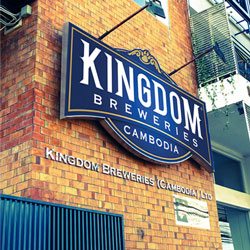
Kingdom Breweries, brewers of Kingdom Pilsner and Dark Lager,
offers regular guided tours of their brewery. For a tour drop by the
brewery Monday-Friday 1:00PM-5:00PM, Saturday 2:00PM-5:00PM.
Admission $7.00. After the tour there is the traditional stop at the
brewery bar, the Taproom, to sample the product.
www.kingdombreweries.com |
|
|
 Cerevisia Craft
Brewery Cerevisia Craft
Brewery
Location: #9, St. 29
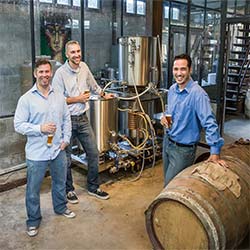
Cerevisia Craft Brewery, In Phnom Penh, Craft Brewhouse is
on a mission: To create damn fine beer. Crafting full-bodied brews
with iconic aromatics and a pleasing finish, we are an innovative
young brewery seeking to distance ourselves from the lager-swilling
masses. At Craft Brewhouse, we don’t cut corners. You will not find
us in every tap room, only the finest.
www.cerevisiacraftbrewery.com
|
|
|
Traditional Markets
In Cambodia it is the women who take charge of trade...
Market is held everyday from six o'clock...
they display their goods on matting spread upon the ground.
Each has an allotted place...
-
excerpt from The Customs of Cambodia by Zhou Daguan circa 1300AD
'Phsar means ‘market’ and a
visit to at least one traditional phsar is a must. A typical traditional
market is a sprawling ground level affair, open-air but covered, crowded
with rows of booths and stalls. If you visit only one or two markets in
Phnom Penh, begin with the Phsar Tuol Thom Poung (Russian Market) and
Phsar Thmey (Central Market.) Both offer curios, souvenirs and a
cultural shopping adventure. Other traditional markets such have fewer
items for tourists but can still be culturally and photographically
interesting. The markets open and close with the sun but are fairly sleepy between 11:30AM and 2:00PM.
|
 Central Market (Phsar Thmei) Central Market (Phsar Thmei)
Hours: Sunrise to sunset
Admission: None
Location: Corner of Street
130 and Street 63
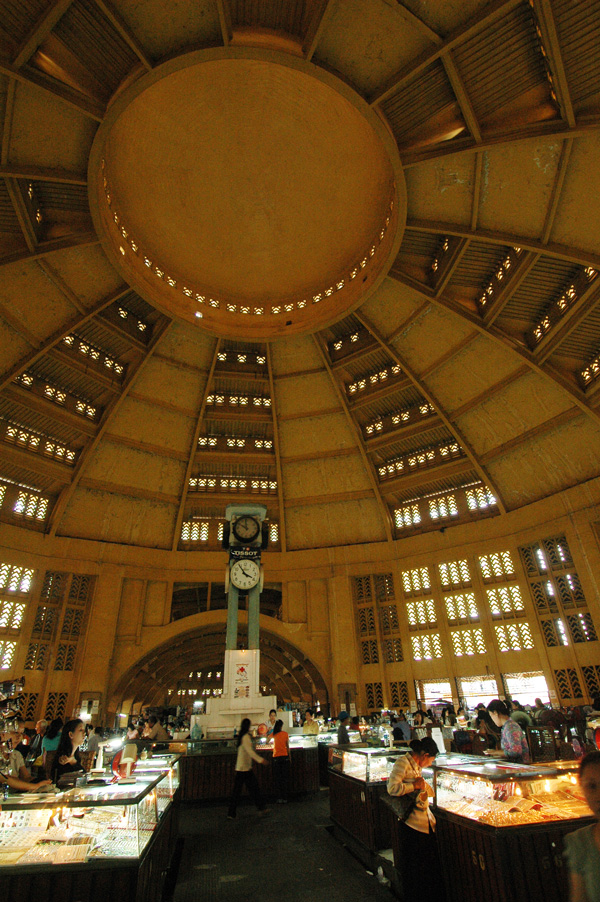
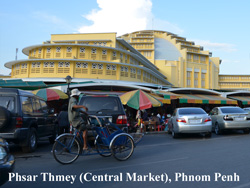
This distinctive building
is a city landmark - a unique Art Deco interpretation of a
traditional market. Four arms of the market converge in a
soaring dome at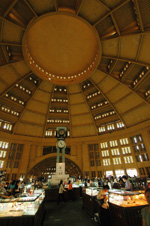 the hub, perhaps reflecting the four arms of the chaktomuk
(the convergence of the Mekong River.) Prior to 1935 the
market area was a swampy lake known as Beng Decho that
received the runoff during the rainy season. The lake was
drained and the market constructed in 1935-37 during the
French colonial period, and originally dubbed the ‘Grand
Market.’
the hub, perhaps reflecting the four arms of the chaktomuk
(the convergence of the Mekong River.) Prior to 1935 the
market area was a swampy lake known as Beng Decho that
received the runoff during the rainy season. The lake was
drained and the market constructed in 1935-37 during the
French colonial period, and originally dubbed the ‘Grand
Market.’
The central section of the market building displays an
amazing collection of gems and jewelry. Souvenir vendors
along the central entrance walk offer curios, statuary,
handicrafts, silks, t-shirts, postcards, etc. (‘Phsar Thmey’
is properly translated ‘New Market’, but ‘Central Market’
has caught on in English.)
|
|
|
|
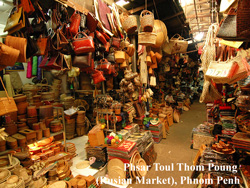 Russian Market (Phsar Toul Tom Poung) (see
market map) Russian Market (Phsar Toul Tom Poung) (see
market map)
Hours: Sunrise to sunset
Admission: None
Location: Street 450, between
Streets 155 and 163
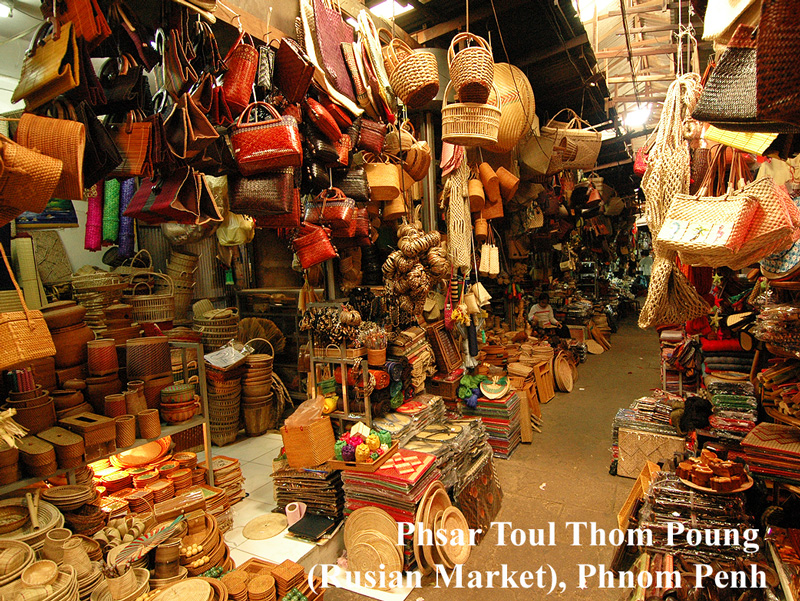
This market became the foreigner’s market during the 1980’s when most of
the foreigners in Cambodia were
Russians, hence the name ‘Russian
Market.’ It is of far less architectural interest than the Central
Market but has a larger, more varied selection of souvenirs, curios and
silks.
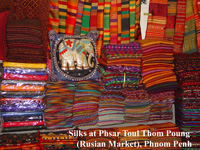 The
Russian Market became the foreigner’s market during the 1980’s when most
of the foreigners in Cambodia were Russians, hence the name ‘Russian
Market.’ It is of far
less architectural interest than the Central Market but has a larger,
more varied selection of souvenirs, curios and silks.
Also unlike the Central Market this is a
classic traditional market - a sprawling, single level collection of
stalls - and offers a larger, more varied selection of souvenirs, curios
and silks.
It is also one of the best markets in town for fabrics and
has the largest selection of DVDs of all the traditional markets. Most
of the DVD vendors are on the south side as are most of the
visitor-oriented places, but the rest of the market is well worth
exploring. There are some good local food and drink stands in the middle
of the market. The
Russian Market became the foreigner’s market during the 1980’s when most
of the foreigners in Cambodia were Russians, hence the name ‘Russian
Market.’ It is of far
less architectural interest than the Central Market but has a larger,
more varied selection of souvenirs, curios and silks.
Also unlike the Central Market this is a
classic traditional market - a sprawling, single level collection of
stalls - and offers a larger, more varied selection of souvenirs, curios
and silks.
It is also one of the best markets in town for fabrics and
has the largest selection of DVDs of all the traditional markets. Most
of the DVD vendors are on the south side as are most of the
visitor-oriented places, but the rest of the market is well worth
exploring. There are some good local food and drink stands in the middle
of the market.
|
|
|
|
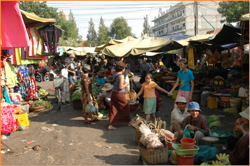 Phsar
Kandal Phsar
Kandal
Hours: Sunrise to
sunset
Admission: None
Location: Street 450, between
Streets 155 and 163
A typical,
sprawling, low-slung local market similar to Phsar Chas.
Meat, vegetables, fruits and tailors fill the
north half while jewelers and electronics stalls are located in the
building next door. It’s a very local scene but as the market is only a
couple of blocks off the riverfront tourists occasionally find their way
to the coffee stalls and noodle shops. There is a comparatively large
Vietnamese population
living in the area around Phsar Kandal, which and is reflected in the
character of the market - the food, the dress and the language.
|
|
|
|
Old Market (Phsar Chas)
Phsar Chas not at all geared to tourists, carrying such items as
fruits
and vegetables, hardware, second hand clothes, motorcycle parts and
religious items. The late afternoon shopping hour along Street 110 and
Street 108 makes for a confusing, dirty, potentially
photogenic scene.
There has been a market on this site since at the earliest days of the
French colonial period (and probably much longer) when it sat next to a
now reclaimed river inlet. |
|
|
|
Night Market (Phsar Reatrey)
Phnom Penh’s new Night Market on the riverfront is aimed squarely at
visitors and tourists, offering a wide and varied selection of Cambodian
handicrafts silks, art, curios and souvenirs. Currently the Night Market
opens from Thursday to Sunday, starting up at about 5:00PM and runs until
at least 10:00 or 11:00PM. Located in the park between Street 106 and 108
on the riverfront. Stop in as you stroll up the riverfront.
|
|
|
|
|
|
|
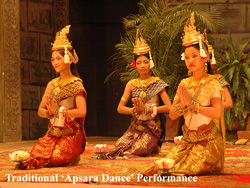
Traditional Performances
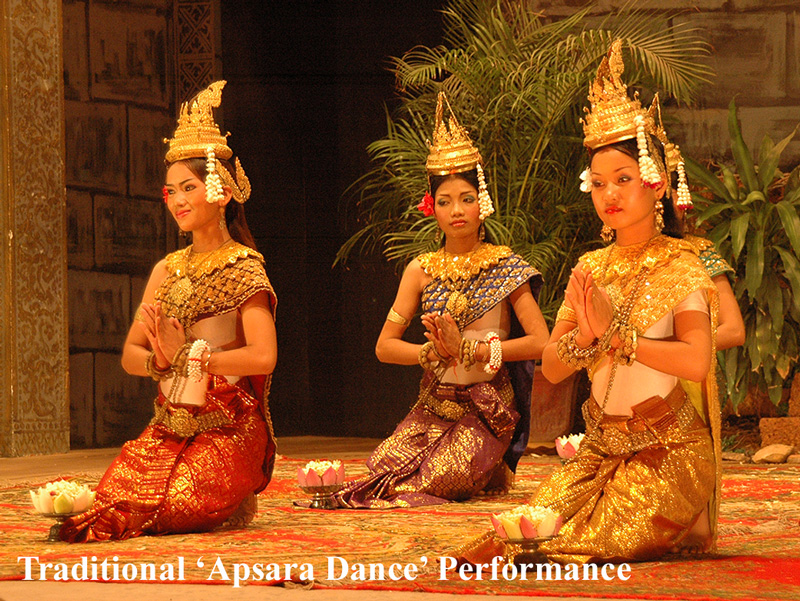
Cambodia has a long and rich history of
classical dance, shadow puppetry and circus, and it has also become
tradition for visitors to Cambodia to attend at least one
traditional performance, most often an ‘Apsara Dance Performance.’
Dozens of restaurants in Siem Reap host nightly performances, but
there are only a few places in Phnom Penh offering regularly
scheduled shows, and for that reason the shows that are available
often offer something a bit unique. It can have a somewhat more
authentic, less canned feeling than what you may find at some of the
'buffet & dance mills' in Siem Reap.
See Traditional
Performances page for more.
|
Traditional Dance
Performance @ the National Museum
The beautiful gardens of the National Museum are the setting
for each 60-minute choreographed performance, including several
different traditional classical and folk dances. Discover the
diversity of Cambodian culture and traditional arts through original
and enjoyable pieces.
Performances (October - March): Mon - Sat, 7:00PM
Performances (April - September): Mon - Sat, 7:00PM
Admission: $15
Located in the garden of the National Museum
Tel: 017-998570
bookings@cambodianlivingarts.org
www.cambodianlivingarts.org
|
|
Sovanna Phum Art Association
Striving to revive and promote Cambodian culture. Classical, Folk
and Contemporary dance, Shadow theatre, Circus and Music are
performed for local and international audiences. Also active in
promoting inter-cultural exchanges by interacting with artists from
other countries as well as working with NGO/IOs on different
educational and awareness projects. Also available for private and
commercial events.
Performances every Friday and Saturday, 7:30PM.
Admission: Adult : $10; Children: $5
#166 Street 99
Tel: 012-837056, 012-846020
www.sovannaphumtheatre.com
www.facebook.com/sovannaphum.art
|
|
|
|
|
Cooking Classes
|
Feel Good Cooking School / Street Food Tours
Khmer cooking classing by experienced Cambodian cooking teachers at
Feel Good Cafe. Featuring a trip to a traditional market to shop for
ingredients. In class, individual cooking stations. Also offering
Evening Street Food Tours.
#79 Street 136 (Feel Good Cafe)
Tel: 098-252533
|
|
La Table Khmere
Well-reviewed Cambodian cooking classes in Boeung Keng Kang 1 (BKK1)
at La Table Khmere restaurant. Daily, half-day classes, morning and
afternoon, including a trip to the market and hands-on preparation
in a modern kitchen environment.
#11A Street 278, BKK1 (La Table Khmere restaurant)
Tel: 012-238068
www.phnompenh-cooking-class.com
|
|
|
|
|
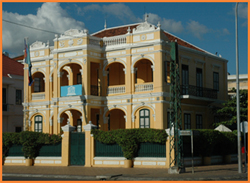 The
Architecture of The
Architecture of
Phnom
Penh
Architecturally speaking, Phnom Penh is a comparatively new city.
Prior to the late 19th century the city was but a few pagodas and
clusters of wooden structures along the riverfront. Almost every
currently existing structure in Phnom Penh was built after the
beginning of the French colonial period in 1863. The oldest part of
the city stretches from the Wat Phnom area south to the Royal
Palace, and is also where you will find most of the surviving
colonial era structures.
‘Chinese shophouse’ style buildings dominate the city, characterized
by deep narrow apartments composed of a combined ground-floor
businessfront and upstairs residence. Standing in distinctive
difference, European influenced colonial period structures are
interspersed through the central city. At the height of the colonial
period Phnom Penh was reputed to be the most beautiful city in
French Indochina - recalling Paris in its manicured parks and
picturesque boulevards lined with ornate villas.
The historical architecture of the old city cener may be divided
into three broad categories:
1) The ubiquitous ‘Chinese shophouse-style’ structures, some as old
as the late 19th century but most later - from the 1900s through the
1960s.
2) Late-19th/early-20th century French Colonial buildings
encompassing a range of influences and styles. Early villa-style
residences and public buildings display an eclectic mix of European
influences. Slightly later structures such as Phsar Thmei reflect
the Art Deco movement and other western styles. Also of this period,
‘Colonial Traditional’ style buildings such as the National Museum
that draw heavily on traditional Cambodian themes. Most of Phnom
Penh’s colonial-era highlights are located within the city center
with clusters near the Royal Palace, around Post Office Square and
Wat Phnom, and dotting Norodom Blvd from Sihanouk to Wat Phnom.
3) ‘New Khmer Architecture’ of the late-1950s/60s, such as the
Chaktomuk Theatre and Independence Monument, built in the
post-colonial ‘Golden-era’ and displaying a modern but distinctively
Cambodian direction. There are only a few examples in the city
center.
For more on the architecture of Phnom Penh check out the books:
‘Phnom Penh Then and Now,’ ‘Cultures of Independence’ and ‘Building
Cambodia: New Khmer Architecture 1953-1970.’
For
more on the architecture
of Phnom Penh and a architecture tour map
and guide, see here.
|
|
|
|
|
|
Pagodas (Wats)
Cambodia is a Theravada Buddhist country, and in Phnom Penh
you are never far from a Buddhist pagoda (wat.) Dozens of
wats dot the city with at least one located in almost every
neighborhood. Though many of the wats are comparatively
modern, Phnom Penh’s original five wats were established in
the 15th century and all are still functioning.
Pagoda grounds are colorful and photogenic places and most
are open and welcoming to the general public. But if you
visit a pagoda please be respectful of the place and people.
Dress conservatively, remove your hat on pagoda grounds,
remove your shoes before entering the vihear (main temple)
and respect the privacy of monks and worshippers. The
following short list of pagodas include some of the city’s
more historic and photogenic wats, as well as being in areas
popular with visitors. See Ray Zepp’s book
‘A
Field Guide to Cambodia Pagodas’
for a more complete list and description of Phnom Penh’s
pagodas.
|
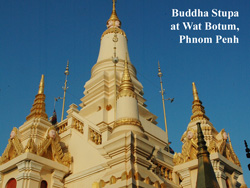 Wat
Botum Wat
Botum
Location: Street 7, 100 meters from the
Royal Palace
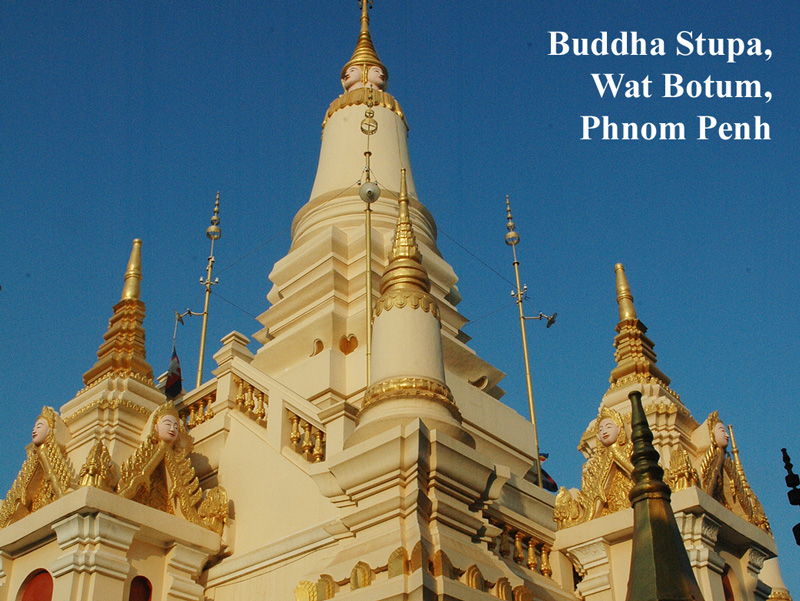
Wat Botum is a colorful, photogenic wat, the
compound crowded with ornate stupas, including the towering ‘Buddha’s
Relic Stupa.’ Though Wat Botum took its present structure in 1937 it is
one of the city’s original wats, possibly founded by King Ponhea Yat in
the 15th century, the first king to rule from Phnom Penh.
|
|
|
|
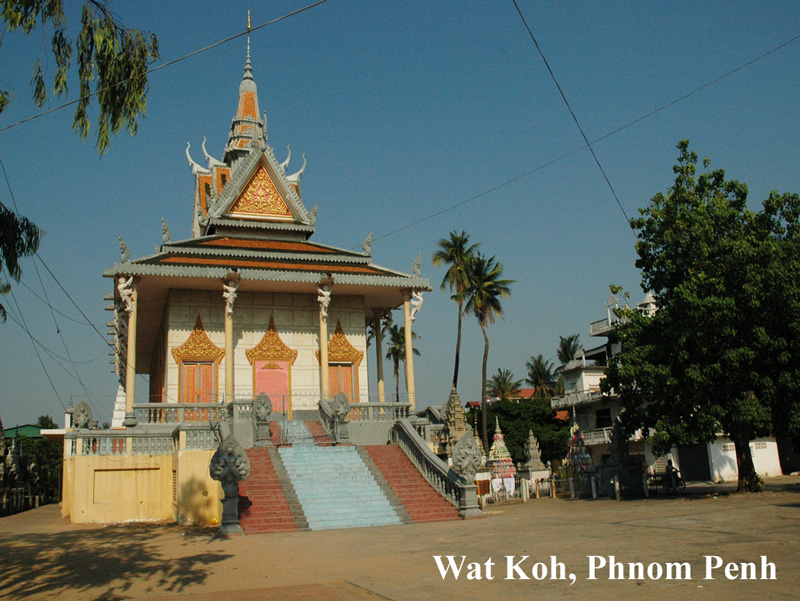
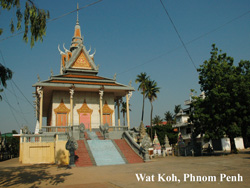 Wat
Koh Wat
Koh
Location: Located in the heart of the
city, on Monivong and Street 174.
One of the city’s five original wats,
established in the early 15th century. The main building was destroyed
in the 1970s and rebuilt in the 90s. This pagoda has become a refuge for
stray and abandoned house pets. If you want to adopt a cat, this is the
place to come.
|
|
|
|
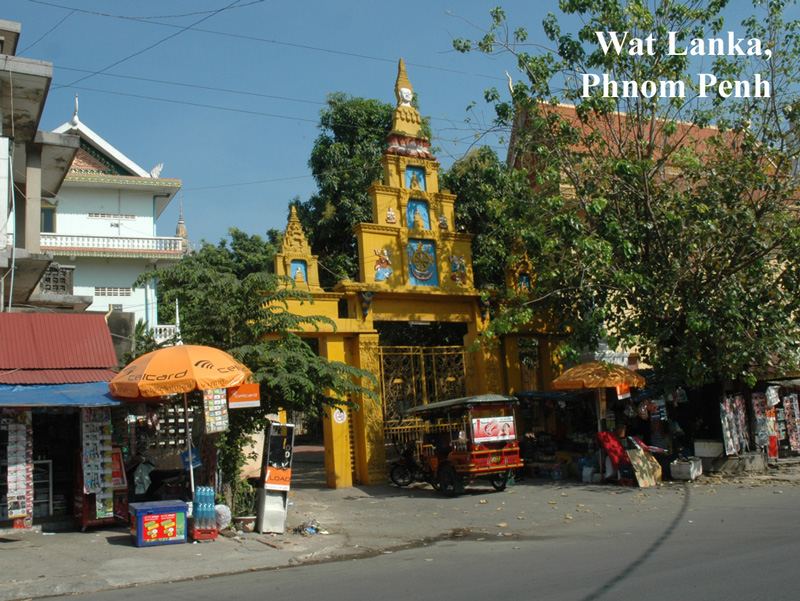
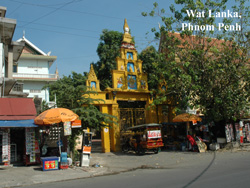 Wat
Langka Wat
Langka
Location: Just southwest of the
Independence Monument
In Boeung Keng Kang (BKK1) near the
Independence Monument. Reputedly one of Phnom Penh’s original wats
(1422). Estab-lished as a sanctuary for the Holy Writings and a meeting
place for Khmer and Sri Lankan monks, and named in honor of the
meetings.
|
|
|
|
Wat
Phnom (see above)
Location: North end of Norodom Blvd.
Small hill crowned by an active wat (pagoda) marks the legendary
founding place of the Phnom Penh. The hill is the site of constant
activity, with a steady stream of the faithful trekking to the vihear,
shrines and fortune tellers on top and a constellation of vendors,
visitors and motodups at the bottom.
The legend of the founding of
Wat Phnom is tied to the beginnings of... (see above) |
|
|
|
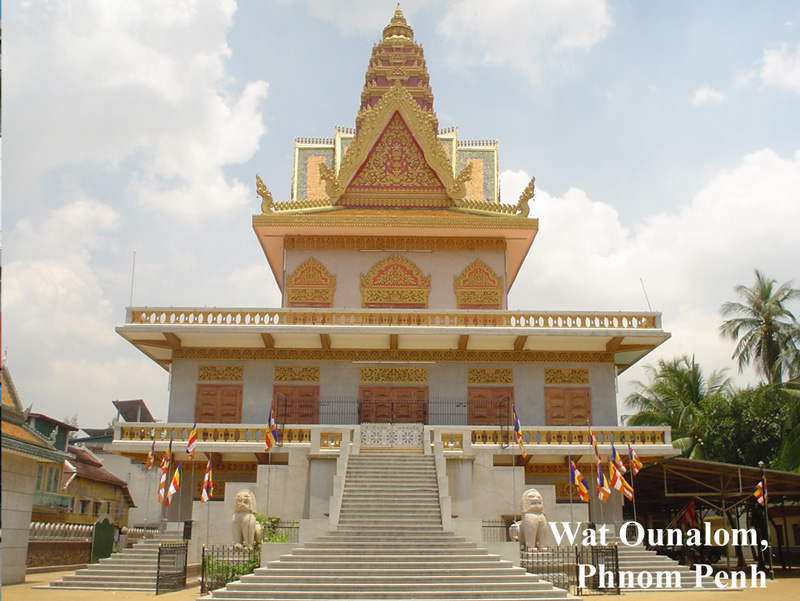
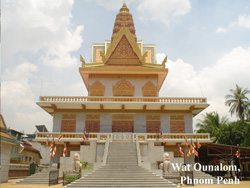 Wat
Ounalom Wat
Ounalom
Location: Sothearos Blvd. about 200m
north of the Royal Palace
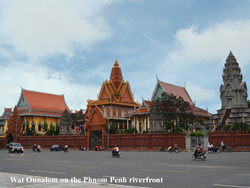
This sprawling pagoda in the heart of the
riverfront district is as impressive from across the street as the
interior - its golden temples and towering stupas defining the
streetscape. It is also particularly accustomed to receiving walk-in
visitors. Wat Ounalom is the home to the Buddhist patriarch and is
reputedly the oldest Buddhist foundation in the city, probably predating
the abandonment of Angkor in the 15th century.
|
|
|
|
|
|
|


|

| | |