|
 Phnom
Penh: Day Trips Phnom
Penh: Day Trips
& Nearby Destinations
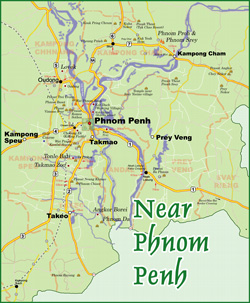
There is a lot of Cambodian
history within a daytrip’s distance of Phnom Penh.
Silk Island, just an hour’s boat ride away,
offers a unique opportunity to see a traditional, working
silk weaving village. An hour or two south of Phnom Penh,
the
Angkorian ruins
of Takeo province, though not as impressive as the ruins
near Siem Reap, still rank amongst the most important in
Cambodia. And an hour west of the city, the picturesque
17th-19th century remains of the royal city of
Oudong
allow you to explore the period of Cambodian history between
Angkor and the colonial period that is neglected in most
tours. And just the process of getting to these sites
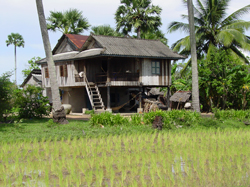
provides a good glimpse of Cambodian rural life - scenic
rice paddies, stilted villages and countryside pagodas.
Most of the places listed are too far for a tuk-tuk. It is
easiest to arrange a tour or transportation through a travel
agent or your hotel, usually a daily tourist van. DIY
options include chartering a taxi, renting a motorcycle or
for the hard core do-it-your-selfer, taking a public bus to
the nearby city and ask to be let off at the site or
turn-off. |
Nearby Destinations
|
 Silk
Island (Koh Dach) Silk
Island (Koh Dach)
Located in the Mekong River located about
1-hour boat ride from Phnom Penh.
Admission: None
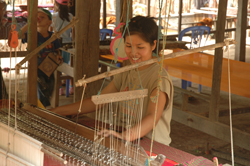
For those with an interest in Cambodian silks and silk weaving, set
aside a half-day for a boat trip to a rural weaving village on Koh Dach
(aka ‘Silk Weaving Island,’) a nearby island up the Mekong River. The
weaving village is a typical rural Cambodian village, dedicated almost
entirely to silk weaving - people operating hand looms under most of the
houses, others dying and spinning silk on spinning wheels made of
bicycle parts. The area does not receive a lot of tourists. Wander the
village to observe the activities, and expect silk sellers to try to
hawk their wares.
Arrange a visit through your guesthouse,
travel agent or see
tour/boat operators. Cambo
Cruise (www.CamboCruise.com
092-290077) offers regularly scheduled daily cruise & tours to the
island for $24-$34 inclusive. If you want to do it yourself, boats can
be chartered for around $20-$25/hour and take about 2-3 hours round trip
plus the time you want to spend there. The boat may stop at ‘Mekong
Island.’ Make sure that the boat operator understands that you want to
go all the way to the silk village on Koh Dach. |
|
|
|
|
|
 Oudong Oudong
Route #5, 1-hour west of Phnom Penh
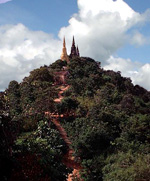
The abandoned royal city of Oudong sits amongst the hills west of
Phnom Penh. Oudong was the capital city of Cambodia from the 17th
century until 1866 when the capital was moved to Phnom Penh. Several temples, stupas and other structures cover three
hills. The walk up the hill provides an excellent countryside view. The
hill is crowned with stupas containing the remains of several Cambodian
kings including King Monivong (1927-1941) and King Ang Duong
(1845-1859). The earliest structure is from the 13th century. These
hills were also the
site of some of the Khmer Rouge’s most prolonged
resistance against the encroaching Vietnamese army in 1979. Several new
temples and shrines have recently been installed on the hill. For
something completely different, take a side trip to ‘Prasat Nokor Vimean
Sour’, a concrete, unduly ornate, semi-replica of Angkor Wat built circa
1998.
Take a Kampong Chhnang/Oudong bound bus. Get off at the billboard in
Oudong town and take a motodup the rest of the way to the site. |
|
|
|
|
|
 Phnom Da/Angkor Borei Phnom Da/Angkor Borei
Takeo Province, 2-hours south of Phnom Penh
Angkor Borei is a small town in the area of several ruins and
archaeological digs. The area has been continuously inhabited for at
least 2500 years and has yielded artifacts dating from the Neolithic
period, the Funan period (4th/5th century AD) and Chenla (8th
century AD) as well as the later Angkorian period (9th-15th century
AD.) There are no significant temple ruins at Angkor Borei but there
is a very interesting little museum displaying artifacts from the
area and providing information on recent archaeological digs.
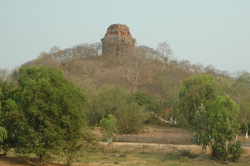
The hill, Phnom Da, sits about 20km from Angkor Borei and is crowned
by an impressive 11th century Angkorian-era prasat (tower)
displaying some carvings in pretty good condition. The temple was
constructed under King Rudravarman and dedicated to Shiva. Further
down the hill is the unique little temple ruin Ashram Maha Rosei,
quite unlike other Khmer monuments in both design and adornment.
Constructed in the late 7th-early 8th century, during the
pre-Angkorian Chenla period, under King Bahavavarman. The temple
shows signs of non-Khmer influence and has unusual north-facing
entrance. The design is reminiscent of Prasat Ashram Isay in the
Sambor Prey Kuk group in Kampong Thom.
Getting there:
During the dry season, Phnom Da can be reached by
road or boat. In the wet season, it can only be reached by boat. By
road: Take the Takeo bound bus (NR2) to the Phnom Chisor turnoff
(52km from Phnom Penh.) Take a motodup or taxi to Phnom Chisor and
then on to Phnom Da. By boat, take the bus to Takeo town. Pick up a
boat to Angkor Borei and Phnom Da. During the dry season you will
stop well short of the hill and will have to hike a ways. |
|
|
|
|
|
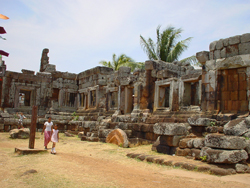 Phnom Chisor Phnom Chisor
Takeo Province, off Rte 2, 2 hours south of Phnom Penh
At the top of Phnom Chisor sit some very nicely preserved 10th/11th
century AD Angkorian era ruins. The temple was constructed under
King Suryavar-man I during a period when the Angkorian-era Khmer
Empire was nearing its apex. As most Angkorian temples
of the
period, this temple is Hindu, dedicated to Shiva and Vishnu. Scenes
including Brahma, Shiva and Vishnu are still visible, carved on some
lintels and pediments. The 503 steps to the temple on top of the
hill make for a fairly vigorous climb but the quality of the ruins
and the amazing view of the countryside make the effort well worth
it. |
|
|
|
|
|
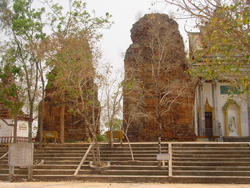 Prasat Neang Khmau Prasat Neang Khmau
Takeo Province, off Rte 2, 1.5 hours south of Phnom Penh
Standing next to an active pagoda, Prasat Neang Khmau consists of two
deteriorating brick prasats (towers) built in the Angkorian-era in the
10th century A.D. under King Jayavarman IV. There was probably at least
one more ancient prasat where the modern pagoda now sits. Prasat Neang
Khmau was originally dedicated to the Hindu god Shiva. The temple
complex is named after Neang Khmau, ‘Black Lady’, a modern-era statue
located in front of the temples. At the 51km road marker. The temples
are on a small hill right next to the road.
|
|
|
|
|
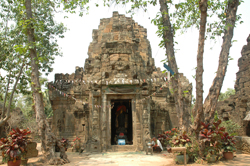 Tonle
Bati/Ta Prohm Tonle
Bati/Ta Prohm
Off Route #2, 1 hour south of Phnom Penh
Tonle Bati is a small lake and popular picnic spot for the locals -
bamboo picnic stands and mats by the water. On the road to Tonle
Bati there are two Angkorian era temples, Ta Prohm and Yeay Peau.
Both temples were built under Jayavarman VII in the late 12th
century during the same period that Bayon
and Angkor Thom in Siem
Reap were constructed. Ta Prohm is the more extensive and impressive
of the two, displaying a number of very well-preserved carvings.
Yeay Peau is a single sandstone tower situated next to an active
pagoda displaying some carvings. The area has been occupied since
the pre-Angkorian Funan period and Ta Prohm was modified and
extended as late as the 16th century. |
|
|
|
|
|
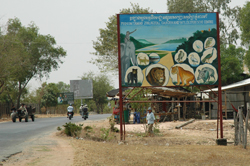 Ta Khmau Zoo / Phnom Tamao / Prasat Tamao Ta Khmau Zoo / Phnom Tamao / Prasat Tamao
Off Route #2, 39km, 1 hour south of Phnom Penh
The Phnom Tamao area is a popular destination for weekend holidayers
from Phnom Penh, offering picnicking, a zoo and some minor Angkorian-era
ruins. The Ta Khmau Zoological Gardens is Cambodia’s newest and best zoo
displaying a variety of animals including lions, tigers, bears, birds
and more. An 11th century, Suryavarman I temple ruin in very poor
condition (Prasat Tamao) sits at the top of Phnom Tamao.
Located off of Route #2 at the 39km mile marker. Turn right. 1000 riel
entrance fee. |
|
|
|
|
Tour Operators
|
|
|
CamboCruise.com
Regularly scheduled, daily river cruises and excursions departing in
front of Yi Sang Riverside/Tourist Information Center just south of the
Royal Place. The Silk Island
Lunch Cruise departs at 12:00PM and returns at 4:00PM, including
optional lunch buffet. A 2 hour Sunset Cruise Dinner departs at
5:00PM, including optional dinner buffet. Live traditional music, free
filtered water, full bar and excellent service on all cruises. Tel
092-290077
cambocruise@icloud.com
www.CamboCruise.com
|
|
CamboCruise boat at
Phnom Penh Tourist Information Center Riverside |
|
|
|
|
|
Hidden Cambodia Adventure Tours
Single and multi-day all-inclusive, high
end, cultural, ad- venture and humanitarian tours by 4WD, dirtbike and
car to Koh Ker, Preah Vihear, Preah Khan temples and historic KR area,
Anlong Veng. Tonle Sap Lake tours.
Tel: 012-655201, Tel: 012-655201
www.hiddencambodia.com
|
|
C/O Siem Reap Post Office,
P.O Box 93058,
Siem Reap |
|
|
|
MotoGirl Tour
Unique city motorcycle tours conducted by
female tour guides. A variety of tours available - sights, adventure,
culture, nightlife.
Phnom Penh Tel: 015-292952
www.motogirltour.com
|
|
Phnom Penh |
|
|
|

|